 Image 1 of 1
Burnout is not a personal failure. It is a capacity signal.
Dental professionals are often taught to respond to exhaustion by becoming more resilient, more efficient, more organized, or simply pushing through.
But what if burnout is telling us something different?
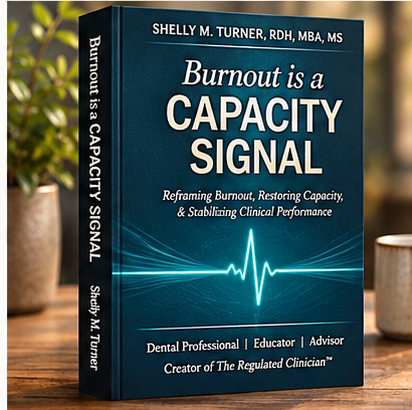
In Burnout Is a Capacity Signal: Reframing Burnout, Restoring Capacity, and Stabilizing Clinical Performance, Shelly M. Turner, RDH, MBA, MS draws on more than three decades in dentistry, education, mentorship, and clinical leadership to challenge the traditional conversation surrounding professional burnout.
Burnout is not simply exhaustion. It can be a signal that the cognitive, emotional, and operational demands of clinical practice have exceeded the clinician’s available capacity.
And when capacity becomes unstable, the effects can reach far beyond how a clinician feels. Focus, communication, decision-making, patient care, team dynamics, leadership, and professional sustainability can all be affected.
Rather than asking clinicians to become better at enduring unsustainable conditions, Turner introduces a structured approach to recognizing the signals of overload, understanding where capacity is being consumed, and creating conditions that support sustainable clinical performance.
Inside, readers will explore how to:
Recognize cognitive, emotional, and operational overload before depletion becomes the norm
Reframe burnout as a capacity issue rather than a personal deficiency
Distinguish cognitive load from emotional absorption
Identify the small, repeated demands that quietly consume clinical capacity
Build greater awareness and regulation into the clinical workday
Create healthier systems, conversations, and leadership practices that support sustainable performance
Written for dental professionals, educators, mentors, managers, and clinical leaders, Burnout Is a Capacity Signal moves the conversation beyond resilience alone and toward something more sustainable: capacity awareness, intentional regulation, and clinical environments designed to support the people working within them.
Because the goal is not to teach clinicians how to tolerate more.
The goal is to recognize when capacity is speaking—and respond before exhaustion becomes the standard.
Burnout is a signal. Capacity can be restored. And sustainable clinical performance can be designed.